
Scientific Quran miracles have fascinated Muslims, researchers, students, and sincere seekers for generations. People are amazed when they find a Quranic verse that speaks about the heavens, the oceans, the human body, water, life, mountains, clouds, animals, and the hidden systems of creation in ways that still invite reflection today.
Many people search for miracles in the Quran because they want to know whether the Holy Quran contains signs that connect with modern science, modern scientific discoveries, and the scientific age we live in. Others search more specifically for scientific miracles in the Quran or miracles in the Qur’an because they have heard claims about embryology, cosmology, the sea, the Big Bang, the expansion of the universe, or the origin of life.
But before we begin, we need to be careful.
The Quran is not a science textbook. It is a book of guidance revealed to Prophet Muhammad ﷺ more than 1400 years ago. Its purpose is not to teach astronomy, embryology, oceanography, or geology as academic subjects. Its purpose is to guide the human being to Allah, correct the heart, awaken the mind, and show signs in creation that point beyond creation itself.
That matters because some claims about “Quran and science” are exaggerated. Some are based on weak interpretations. Some force modern scientific theories or scientific explanations into a verse where they do not belong. A sincere Muslim does not need weak arguments to honor Islam or the Quran.
At the same time, some Quranic verses are so striking, so layered, and so beautifully connected to the natural world that they continue to inspire reflection as human knowledge grows.
This article explores 15 scientific Quran miracles with a balanced approach: what the Quran says, what modern science observes, what we should avoid overclaiming, and what each miraculous sign should do to the heart.
This guide answers the most common questions people ask about scientific Quran miracles:
Scientific Quran miracles should increase reflection, not create careless arguments.
The strongest examples are those that respect the Arabic wording, the Quranic context, reliable tafsir, and established scientific knowledge. The weakest examples usually depend on selective numerology, viral social media posts, or claims that sound exciting but collapse under careful reading.
The Quran repeatedly invites people to look at the sky, the earth, water, life, the human body, animals, rain, night, day, and the order of creation. These signs are not meant to entertain us for a few minutes. They are meant to humble us and turn the heart back to Allah.
Science can describe how natural systems work. Revelation tells us why they matter.
Before looking at the 15 examples, we need a clear method.
A strong scientific Quran miracle claim should meet five conditions.
First, the explanation should fit the Arabic wording of the verse. If the Arabic meaning has to be stretched beyond recognition, the claim becomes weak.
Second, the interpretation should not contradict the broader Quranic context or recognized tafsir. The Quran should not be forced to say something just because a modern reader wants it to sound scientific.
Third, the scientific observation should be well established. It is risky to attach the Quran too tightly to a scientific theory that may be revised later.
Fourth, the claim should avoid exaggeration. For example, saying “the Quran points to a natural sign that modern science helps us appreciate” is often more accurate than saying “this verse gives a complete scientific formula.”
Fifth, the result should lead to reflection on Allah, not just intellectual excitement.
This method also protects the reader from treating every modern scientific discovery as if the Quran had already stated it in technical detail. The Quran contains guidance, signs, warnings, stories, laws, and reminders. It also describes the heavens and the earth in ways that invite reflection. But the whole Quran should not be reduced to a list of modern scientific claims.
This is especially important when discussing popular topics such as the Big Bang, black holes, tectonic plates, or modern embryology. These subjects can be useful for reflection, but they should not be forced into a verse if the Arabic wording, Quranic context, or reliable tafsir does not support the connection. Even a real scientific fact should not be used carelessly if the verse itself does not carry that meaning.
The Quran itself repeatedly frames creation as ayat — signs. A sign points beyond itself. Water is not only water. The sky is not only atmosphere. The sea is not only salt and depth. The embryo is not only biology. Each created thing becomes a doorway to knowing the Creator.
That is why serious Quran reflection begins with learning how to read the Quran properly, understand its language, and approach it with humility. For readers who want to build that foundation, Hafizon’s complete guide to learning Quran online explains how beginners can start with Quran reading, Tajweed, memorization, and structured learning step by step.

One of the most discussed scientific Quran miracles is connected to Surah Adh-Dhariyat 51:47, where the Quran describes the heaven with language of power and expansiveness.
Modern cosmology recognizes the expansion of the universe. NASA explains that distant galaxies show cosmological redshift as light stretches across expanding space, and that farther galaxies appear to recede faster — a relationship known as Hubble’s Law. (NASA Science)
Some readers also connect this Quran verse with broader discussions about the Big Bang and cosmic origins. Astronomers describe the universe on a scale of billions of years, and current scientific cosmology studies galaxies, redshift, expansion, and the large-scale structure of the universe.
But this verse should not be reduced to a technical statement about the Big Bang model. The Quran should not be forced into every modern cosmology topic. The stronger reflection is that the Quran points the human eye upward and invites people to recognize power, vastness, expansion, and divine control.
The real miracle is not merely that the universe expands. The deeper sign is that the Quran teaches people to look at the heavens with humility rather than arrogance.
The Quran says in Surah Al-Anbiya 21:33 that the day, night, sun, and moon are created by Allah, and that each travels in an orbit.
This verse draws attention to movement and order in the heavens. Modern astronomy confirms that celestial bodies move within ordered systems. The Earth orbits the Sun. The Moon orbits the Earth. Planets, comets, asteroids, and other bodies move in repeating paths governed by gravity.
The Quranic language is not random. It does not describe the sun and moon as chaotic objects floating without order. It frames them as moving within appointed courses.
This is a powerful reflection because the heavens appear still to the casual eye. A person looks up and sees a calm sky. But behind that stillness is immense motion: Earth rotating, planets moving, the Moon circling, stars moving, and galaxies traveling through space.
The Quran teaches the believer to see order where others may see habit.
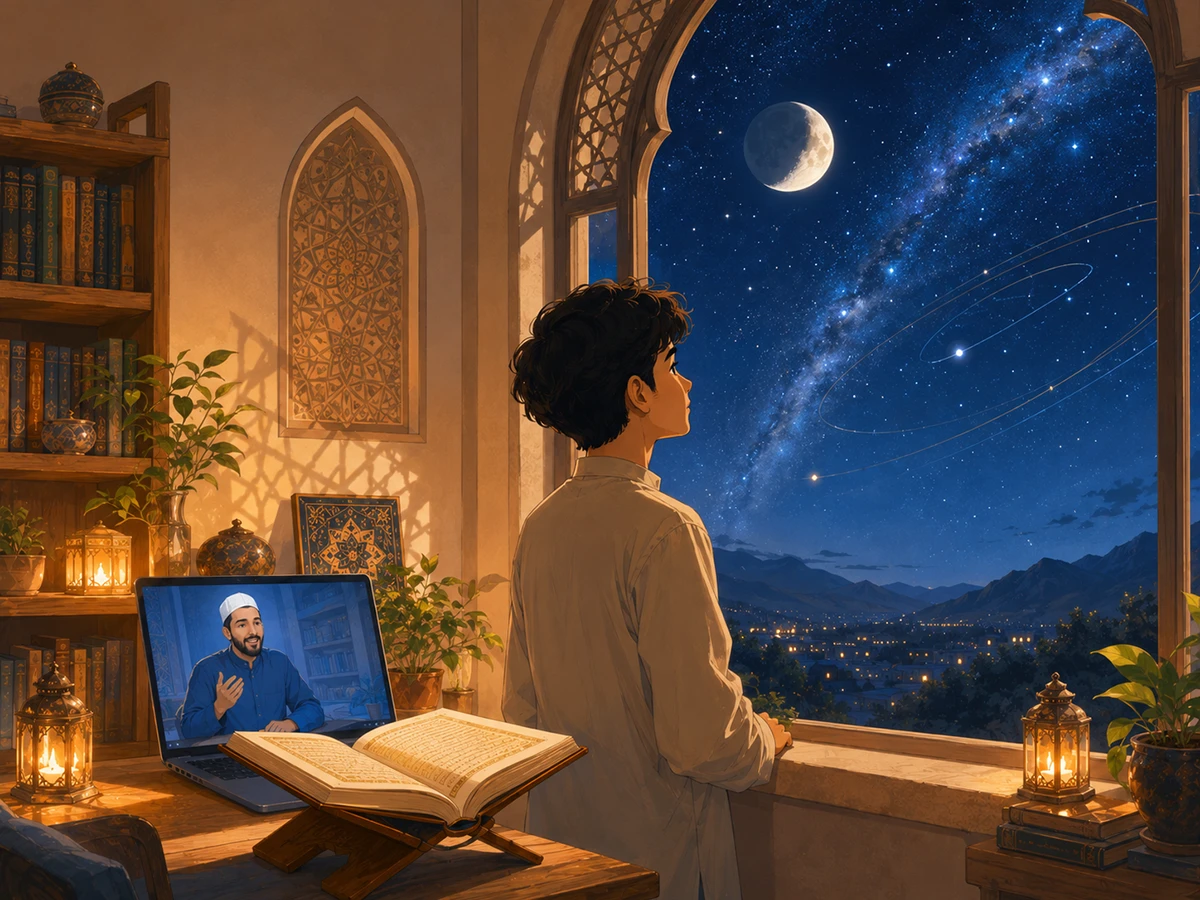
The Quran says in Surah Al-Anbiya 21:30 that Allah “made from water every living thing.” This Quranic verse is one of the clearest and strongest examples often mentioned in discussions about scientific miracles in the Quran.
Modern biology recognizes water as essential for life as we know it. NASA explains that all life on Earth needs water and that water supports cell functions and the chemistry of life. (NASA Science)
The phrase “made from water every living thing” is simple, but that simplicity is part of its power.
Water is so common that people forget how miraculous it is. It falls from the sky, flows through rivers, fills seas, enters the body, supports cells, carries nutrients, cools the earth, and revives dead land.
The Quran does not merely say that water is useful. It connects water to life itself.
A glass of water on your table becomes a sign. Rain becomes a sign. A river becomes a sign. The water inside your own body becomes a sign.
The more science studies life, the more obvious the importance of water becomes. The more the believer studies the Quran, the more deeply he sees that this everyday substance is a mercy from Allah.
The Quran in Surah Al-Mu’minun 23:12–14 describes the creation of man from an extract of clay, then through stages of development in the womb. The passage mentions a clinging form, then a stage often translated in English as a clot or a lump-like stage, then bones, then bones with flesh, and finally “another creation.” The passage ends with the powerful phrase: “So Blessed is Allah, the Best of Creators.”
This passage is often discussed in relation to embryology. Modern medical references describe pregnancy through stages: a fertilized egg develops into a blastocyst, then an embryo, then a fetus. Merck Manual explains that the blastocyst implants in the uterine wall, the embryo develops within the amniotic sac, and the fetal stage follows the embryonic stage. (Merck Manual)
Here, care is important. We should not pretend the Quran is presenting a modern embryology textbook with laboratory terminology. That is not the Quran’s style.
The word often translated as “clot” should not be oversimplified. Many translators and teachers explain it with meanings such as a clinging form or clinging substance, so the article should avoid reducing the Arabic word to one modern medical image.
The striking point is that the Quran draws attention to ordered development inside the womb, a hidden world that human beings could not observe directly in ordinary life. The verse moves the reader from origin to dependency to formation to creation.
The spiritual effect is even more important than the scientific discussion.
You began as something helpless. You did not design your own body. You did not choose your organs, bones, face, skin, or breath. You were formed in darkness, sustained without awareness, and brought out as a living soul.
Scientific detail should make this verse feel even more humbling, not merely more impressive.
The Quran says in Surah Al-Anbiya 21:32 that Allah made the sky a protected ceiling, yet people turn away from its signs.
Modern science shows that Earth’s atmosphere plays a major protective role for life. NASA explains that stratospheric ozone acts as a shield that protects Earth’s surface from harmful ultraviolet radiation. (NASA Science)
This makes the Quranic phrase deeply reflective.
The sky is not merely empty space above us. It is part of the life-supporting system Allah created around Earth. It protects, filters, shields, and surrounds.
A person may look at the sky and think only of clouds or color. The Quran trains the believer to see protection.
Every breath is under that protected ceiling. Every child playing outside, every tree growing, every animal walking, every prayer made under open sky — all of it happens beneath a mercy people often ignore.
Surah An-Nur 24:40 gives a powerful image of darkness in a deep sea, covered by waves above waves, with darkness layered upon darkness.
This verse is part of a larger spiritual comparison, but its natural imagery is striking. NOAA explains that only a small amount of light penetrates beyond 200 meters in the ocean, and that below 1,000 meters sunlight does not penetrate; that aphotic zone is in darkness. (NOAA Ocean Service)
The Quranic image of layered darkness in the deep sea becomes even more powerful when read with this knowledge.
A person standing at the shore sees beauty. A sailor sees waves. But the deep ocean contains a hidden world of pressure, cold, darkness, and layered environments beyond ordinary sight.
The verse uses that image to explain spiritual darkness — not just physical darkness. The scientific observation deepens the metaphor. It shows how powerful the image is.
The human heart without guidance can be like that: darkness within darkness, covered by layers it cannot escape except by light from Allah.
The Quran speaks in Surah Ar-Rahman 55:19–20 about two seas meeting with a barrier between them, and another verse, Surah Al-Furqan 25:53, mentions fresh and salty waters with a partition between them.
This is often discussed as a scientific miracle, but it must be explained accurately. The claim should not be “seas never mix.” That is scientifically inaccurate. Water bodies do mix over time.
The more careful reflection is that water masses can meet while maintaining different properties for a period or across transition zones because of salinity, temperature, density, tides, and currents. NOAA explains that deep-ocean currents are driven by density differences controlled by temperature and salinity, a process known as thermohaline circulation. (NOAA Ocean Service)
So the powerful reflection here is not a cartoon image of two walls of water that never interact. It is the reality that even meeting waters follow laws, boundaries, gradients, and measures.
The Quran points to order in places that look fluid and uncontrolled. Even the sea has limits known to Allah.
The Quran repeatedly speaks about clouds, winds, rain, and water stored in the earth. Surah Ar-Rum 30:48, for example, describes winds stirring clouds, clouds spreading through the sky, and rain coming from them.
Modern science describes the water cycle through evaporation, condensation, precipitation, runoff, and groundwater movement. The U.S. Geological Survey explains that evaporation moves water from Earth’s surface to the atmosphere, and that on a global scale, the amount of water evaporating is about the same as the amount delivered back to Earth as precipitation. (USGS)
The Quran’s rain verses are not dry meteorology. They are spiritual reminders.
Rain descends. Land revives. Seeds open. Rivers flow. Animals drink. Humans harvest. The same water cycle that a textbook may describe as a natural system is presented in the Quran as mercy, provision, and resurrection imagery.
The Quran often connects rain to the revival of dead land, reminding the reader that the One who revives the earth after death can also resurrect human beings after death.
Science explains the mechanism. Revelation reveals the meaning.

Another verse describes mountains with powerful imagery. Surah An-Naba 78:6–7 reminds the reader how Allah made the earth spread out and describes mountains as pegs.
Mountains are often discussed in relation to geology, roots, stability, tectonic plates, and isostasy. Here again, careful wording matters. We should avoid the overclaim that mountains simply “stop earthquakes.” Geology is more complex than that, especially when tectonic plates, faults, crustal movement, and seismic activity are involved.
The Quranic word picture of mountains as pegs is powerful because a peg is partly visible and partly hidden. The visible part is not the whole structure.
Even if we avoid exaggerated claims, the reflection remains strong: mountains are not just scenery. They are signs of scale, weight, formation, and hidden depth.
A person sees the peak. Allah knows the root.
Surah Al-Hadid 57:25 says that Allah sent down iron, in which there is great strength and benefits for people.
Iron is one of the most important materials in human civilization. Britannica describes iron as the most-used and cheapest metal, second in abundance among metals in Earth’s crust, and a major element in Earth as a whole. Britannica also notes that iron is relatively plentiful in the Sun and other stars. (Encyclopaedia Britannica)
The verse emphasizes both strength and benefits. This is immediately recognizable. Human civilization has depended heavily on iron for farming tools, weapons, architecture, industry, transport, and infrastructure.
Some discussions also connect iron with stellar processes and meteorite material. That can be a meaningful reflection, but the safest and strongest point in the verse is already clear: iron contains great strength and immense human benefit.
The Quran asks us to see a metal not merely as a material, but as provision.
A believer can look at a bridge, a tool, a machine, or even the iron in the bloodstream and remember that Allah placed benefit in creation before human beings knew how to fully use it.
The Quran says in Surah Ya-Sin 36:36 that Allah created pairs from what the earth produces, from human beings themselves, and from things people do not know.
This verse points to pairing in creation. The clearest examples are biological: male and female in humans and animals, and reproductive pairings in plants.
In botany, pollination involves pollen transfer so that fertilization and seed production can occur. Britannica explains that pollination is the transfer of pollen grains from the stamens to ovule-bearing organs or ovules. (Encyclopaedia Britannica)
The verse also includes the phrase “from what they do not know,” which leaves the reader humbled. Human beings know some pairings, but not all. Creation contains layers of correspondence, contrast, complementarity, and interdependence.
This does not mean we should force the verse into every modern physics concept. It is enough to say that the Quran points to a broad pattern in creation: things are not isolated, self-sufficient, and random. Creation is filled with relationships.
The believer sees pairs and remembers dependence. Nothing created is absolute. Everything created is limited. Only Allah is One, independent, and unlike His creation.
The Quran says in Surah Al-Hijr 15:22 that Allah sends fertilizing winds and then sends down water from the sky.
This verse is often discussed in relation to the role of winds in pollination and rain systems.
Wind is one of the natural agents involved in pollen transport for many plants. Britannica explains that, in flowering plants, pollen transfer can be carried by wind, water, and animals, especially insects and birds. (Encyclopaedia Britannica)
Wind is also deeply connected to weather and cloud movement. The Quran frequently mentions winds in connection with clouds, rain, mercy, and sometimes punishment.
The scientific reflection is simple but beautiful: invisible air movement can carry life, seed, pollen, clouds, and rain. Something unseen can become the means by which visible life appears.
The spiritual reflection is even deeper. Allah’s mercy may come through causes people barely notice.
A breeze can be a sign. A cloud can be a sign. A seed carried by wind can be a sign. Rain arriving after dry heat can be a sign.

Surah An-Naml 27:18 narrates an ant warning other ants to enter their homes so that Prophet Sulayman and his army would not crush them unknowingly.
The verse presents an ant communicating a warning to other ants. Modern science recognizes that ants have complex communication systems, especially through chemical cues, pheromones, tactile signals, and organized colony behavior. Research on ant behavior regularly discusses how pheromone signaling helps ants coordinate movement, foraging, and colony activity.
The Quranic point is not that this verse is an entomology textbook. It is part of the story of Prophet Sulayman, peace be upon him, and Allah’s gift to him.
But the natural detail is still remarkable. A tiny creature, often ignored by humans, lives in a community with warning, organization, and communication.
The verse teaches humility. Human beings are not the only organized creatures on Earth. Even an ant valley contains structure known to Allah.
A person may step over ants without thinking. The Quran makes him pause and listen.
The Quran says in Surah An-Nahl 16:66 that there is a lesson in cattle, from whose bodies comes pure milk that people drink.
This verse turns attention to something familiar: milk.
Modern physiology shows that milk production involves complex processes inside the body. NCBI Bookshelf explains that milk fat, lactose, and proteins are synthesized in cells from precursors absorbed from blood, and that major blood precursors for milk synthesis include glucose, acetate, triglyceride fatty acids, and amino acids. (NCBI Bookshelf)
The Quranic verse is not interested in technical biochemical detail. It asks the reader to notice the wonder: from within the body, through hidden processes involving digestion, blood supply, and specialized glands, comes a pure drink that nourishes.
Milk is familiar, but familiarity can blind people.
The Quran breaks that blindness.
It says: look again.
The animal eats. Digestion happens. Blood circulates. Glands produce. A pure drink emerges. A child is nourished. A family drinks. A civilization benefits.
What people call ordinary is often only a miracle repeated so frequently that they stop noticing it.
Surah An-Nisa 4:56 speaks about skins being replaced so that punishment is tasted. This verse appears in the context of the Hereafter, so it should be handled with seriousness and not reduced to a casual “science fact.”
At the same time, the connection between skin and pain sensation is medically meaningful. NCBI Bookshelf explains that nociceptors — receptors responsible for relaying nociceptive information — are found on the skin, joints, viscera, and muscles, and that these receptors can be activated by temperature extremes, high pressure, and tissue damage. (NCBI Bookshelf)
This gives the verse an added layer of reflection. Skin is not only a covering. It is part of the human sensory system. Through it, a person feels heat, injury, and pain.
The spiritual lesson is severe: the One who created the body knows its pathways of sensation. Nothing about human creation is hidden from Allah.
For the believer, this verse should not produce curiosity alone. It should produce fear of Allah, repentance, and awareness of the seriousness of the Hereafter.

After reading these examples, it is easy to become fascinated by the science. The expanding universe, ocean darkness, embryonic development, water, winds, mountains, ants, milk, and skin are all remarkable.
But the Quran does not mention signs so that people can merely say, “That is interesting.”
The Quran mentions signs so that people return to Allah.
A sign is not the destination. It points beyond itself to the Creator.
The sky points beyond the sky.
Water points beyond water.
The womb points beyond biology.
The sea points beyond oceanography.
The ant points beyond entomology.
The body points beyond anatomy.
Every created thing is limited. Every created thing depends on something else. Every created thing is measured, sustained, and controlled.
The human being sees causes. The Quran teaches him to see the Causer.
This is why scientific Quran miracles should create humility, not arrogance. They should make the believer more careful with the Quran, not more careless. They should make the reader want to recite better, understand more deeply, and live more sincerely.
The modern discussion around scientific miracles in the Quran became especially popular in the 20th century. Writers such as Maurice Bucaille helped popularize the idea of reading Quranic verses alongside modern scientific understanding; bibliographic listings of his book The Bible, the Qur’an and Science place it within the subject areas of Quran and science, Islam and science, and religion and science. (Open Library)
This history is useful to know, but it should not replace careful reading. Some readers also encounter references to a “Commission on Scientific Signs” or similar organizations and speakers. But no modern writer, committee, video, or viral post should be treated as proof by itself.
Some so-called scientific miracle claims are strong enough to invite reflection, while others are weak, forced, or based on selective wording. The goal of this article is not to repeat every popular claim. The goal is to examine the miraculous nature of these verses with caution, respect for tafsir, and intellectual honesty.
Not every viral claim about the Quran and science is reliable. A strong believer should not be afraid of careful thinking. Truth does not need exaggeration.
Science changes. Interpretations develop. Measurements improve. Theories are revised. If someone attaches a Quranic verse too tightly to a specific scientific model, then later changes in that model may confuse people.
The safer method is to say: “This verse invites reflection, and modern observations make that reflection even more powerful.”
A Quranic interpretation should begin with the Arabic language and recognized tafsir, not with a science headline.
If a claim only works in one modern translation but collapses when checked against Arabic usage, it should be treated carefully.
The Quran is greater than a science textbook. Textbooks become outdated. The Quran remains guidance.
Science can help us appreciate some signs, but the Quran’s authority does not depend on whether a modern reader can match every verse to a laboratory fact.
Some claims sound exciting but are not strong enough to rely on. Examples include selective numerical patterns, exaggerated claims that “seas never mix,” or oversimplified statements like “mountains stop earthquakes.”
A weak argument can harm trust. A careful explanation protects the honor of the Quran.
Some readers try to connect every modern topic — black holes, tectonic plates, DNA, quantum physics, or the Big Bang — to a Quranic verse. This approach can weaken the discussion if the connection is not supported by Arabic meaning, tafsir, and reliable knowledge.
The better method is to let the Quran guide the reflection, not force the verse to follow a modern headline.
Scientific evidence can help a reader appreciate a Quranic verse, but it should not be used carelessly. The Quran is a miracle in its guidance, language, preservation, recitation, and effect on human hearts. Scientific reflections may support faith, but faith should not depend on weak or exaggerated scientific arguments.
Some people phrase the argument as: “The Quran contains scientific knowledge that could not have been known at the time.” That may be how many Muslims describe certain signs, but the article should not depend on that shortcut. The safer and stronger approach is to begin with the Quranic wording, then tafsir-aware reading, then current scientific understanding.
| Stronger Reflection Areas | Why They Are Stronger |
|---|---|
| Water as the basis of life | Clear Quranic wording and widely established biological importance |
| Celestial order and orbits | Repeated Quranic theme of ordered motion in the heavens |
| Deep sea darkness | Strong natural imagery supported by ocean depth and light penetration |
| Embryological stages | Powerful reflection when explained carefully without forced technical mapping |
| Protective sky | Meaningful connection to the atmosphere’s life-supporting and protective role |
| Winds and rain | Strong connection to pollination, weather systems, and cloud movement |
| Claims to Treat Carefully | Why They Need Caution |
|---|---|
| “Seas never mix” | Water bodies do mix; boundaries and gradients are more accurate |
| “Mountains stop earthquakes” | Geology is complex; avoid oversimplification |
| Exact modern embryology mapping | Can become forced if every word is mapped to a technical term |
| Big Bang claims | Useful for reflection, but should not be forced into a verse without careful tafsir |
| Black holes | Not every cosmic object mentioned in modern astronomy has a direct Quranic verse attached to it |
| Tectonic plates | Relevant to geology, but mountain verses should not be reduced to one modern geological model |
| Numerology claims | Often selective and inconsistent |
| “Best scientific proof” claims | Usually vague and can create more confusion than clarity |
| Viral miracle lists without sources | Frequently lack Arabic, tafsir, and scientific verification |
The careful approach does not weaken faith. It strengthens it.
A Muslim does not need to exaggerate science to believe in the Quran.
The Quran’s miracle is not limited to scientific reflections. Its guidance, preservation, recitation, language, law, spiritual power, moral clarity, and effect on human hearts are all part of its enduring miracle.
Scientific reflections are one doorway. They are not the whole building.
A person may enter through the doorway of astronomy. Another through the ocean. Another through the human body. Another through the beauty of recitation. Another through grief and healing. Another through learning Arabic. Another through seeing a child memorize Quran.
What matters is where the sign leads.
If it leads to humility, gratitude, prayer, repentance, and love for Allah’s words, then it has served its purpose.
This is why the next step after reading about scientific Quran miracles should be deeper engagement with the Quran itself. If you want to move from interesting facts to real connection, begin with recitation, understanding, and guided learning. Hafizon’s guide on how to learn Quran online from the beginning can help you see the learning path clearly.
Scientific Quran miracles are one part of a larger conversation about Quran, reflection, and human well-being.
Many readers who are interested in Quran and science also ask how Quran recitation affects the heart, mind, stress, focus, and daily life. For a deeper look at this area, read Quran and Mental Health: Scientific Studies Review, which explores how Quran recitation connects with calmness, emotional balance, stress relief, and spiritual focus.
Another related topic is the physical effect of Quran recitation: breathing, rhythm, relaxation, voice control, and the body-mind connection. You can continue with Physical Health Benefits of Quran Recitation, which explains how recitation may support physical calm, regulated breathing, and a more peaceful learning routine.
These related topics should support the reader’s curiosity without distracting from the main subject of this article.

Scientific Quran miracles can amaze the mind. But the deeper transformation begins when you can read the Quran, recite it correctly, hear its rhythm, understand its message, and return to it again and again.
Many people love reading lists of Quran miracles, but still feel distant from the Quran itself.
They may not know how to read Arabic letters.
They may struggle with pronunciation.
They may feel unsure about Tajweed.
They may want their children to connect with the Quran but do not know where to start.
They may read translations but wish they could engage with the original words more directly.
That is where structured Quran learning helps.
Hafizon Academy offers online Quran classes for children and adults with one-on-one teacher support. A free trial Quran class can help assess your level, identify recitation mistakes, and suggest a clear path for Quran reading, Tajweed, memorization, or beginner learning.
If these signs made you want to connect with the Quran more deeply, you can book a free trial Quran class and take the first step toward reading the Quran with more confidence and understanding.
Scientific Quran miracles are Quranic verses that many readers connect with later scientific discoveries or natural observations. The strongest examples are those that respect the Arabic wording, Quranic context, recognized tafsir, and reliable science.
No. The Quran is a book of guidance. It speaks about creation as signs that lead people to reflect on Allah. It is not written like a technical textbook, and it should not be reduced to scientific facts alone.
No. Some are strong reflections, while others are exaggerated or based on weak interpretations. A reliable claim should be checked against Arabic wording, tafsir, and established scientific knowledge.
There is no single agreed answer. Commonly discussed examples include water as the basis of life, celestial order, embryological stages, deep sea darkness, the protective sky, and the expanding universe.
Science can support reflection on signs in creation, but faith is not based only on scientific trends. The Quran’s truth is recognized through revelation, guidance, language, preservation, and its transformative effect on hearts and lives.
Overstated claims can weaken trust. A careful approach protects the honor of the Quran and helps readers appreciate its signs without forcing meanings onto the text.
Start by learning correct Quran reading, basic Arabic, Tajweed, and reliable tafsir. A qualified teacher can help you avoid mistakes and build a stronger relationship with the Quran.
Scientific Quran miracles can blow your mind, especially when you remember that the Holy Quran was revealed more than 1400 years ago to Prophet Muhammad ﷺ in a world without modern laboratories, satellites, submarines, telescopes, or advanced medical imaging.
But the Quran does more than amaze the mind.
It wakes the heart.
It teaches the human being to look again at things he thought were ordinary: water, rain, sky, mountains, the womb, the sea, animals, plants, iron, skin, and stars.
It turns the world into a book of signs.
But those signs are not meant to end in curiosity. They are meant to lead to Allah.
The Quran contains signs that speak to every generation. Some signs touch the heart through worship. Some touch the mind through reflection on the heavens and the earth. Some become even more powerful when modern scientific understanding helps us appreciate the depth of what the Quran describes.
The expanding universe should make us humble.
The water that gives life should make us grateful.
The darkness of the deep sea should make us seek light.
The stages of the womb should make us remember our weakness and say, as the Quran teaches: “Blessed is Allah, the Best of Creators.”
The protective sky should make us recognize mercy.
The order of the heavens should make us trust the One who controls all order.
The most powerful way to appreciate scientific Quran miracles is to keep learning the Quran itself — with humility, knowledge, and sincere reflection. If these signs made you want to connect with the Quran more deeply, you can book a free trial Quran class with Hafizon Academy and take your first step toward reading, reciting, and understanding the Quran with confidence.

