
Every night before he slept, the Prophet ﷺ would recite two verses. Not because they were short. Not because they were easy to memorize. But because he had been given them directly — from beneath the Throne of Allah — as a gift meant for exactly the weight a Muslim carries at the end of a day.
These are those two verses of Surah Baqarah.
By the time you finish reading, you will know:
| Detail | Value |
|---|---|
| Surah | Al-Baqarah (The Cow) — Chapter 2 |
| Ayat | 285 and 286 |
| Juz | Juz 3 (end) |
| Revelation Type | Madani — revealed in Madinah |
| Recommended Time | Before sleeping — established in Sahih Bukhari & Muslim |
| Special Status | Revealed as a gift from beneath the Throne of Allah — given to no prophet before Muhammad ﷺ |
Al-Baqarah is the second and longest surah of the Quran, consisting of 286 verses — and its final two are among the most recited in the entire scripture. The last 2 ayats of Surah Baqarah are presented below in full Uthmanic script. Read them carefully before moving to the transliteration — letting the Arabic settle visually is the first step toward memorization.
Ayat 285:
ءَامَنَ ٱلرَّسُولُ بِمَآ أُنزِلَ إِلَيْهِ مِن رَّبِّهِۦ وَٱلْمُؤْمِنُونَ ۚ كُلٌّ ءَامَنَ بِٱللَّهِ وَمَلَائِكَتِهِۦ وَكُتُبِهِۦ وَرُسُلِهِۦ لَا نُفَرِّقُ بَيْنَ أَحَدٍ مِّن رُّسُلِهِۦ ۚ وَقَالُوا۟ سَمِعْنَا وَأَطَعْنَا ۖ غُفْرَانَكَ رَبَّنَا وَإِلَيْكَ ٱلْمَصِيرُ
Ayat 286:
لَا يُكَلِّفُ ٱللَّهُ نَفْسًا إِلَّا وُسْعَهَا ۚ لَهَا مَا كَسَبَتْ وَعَلَيْهَا مَا ٱكْتَسَبَتْ ۗ رَبَّنَا لَا تُؤَاخِذْنَا إِن نَّسِينَا أَوْ أَخْطَأْنَا ۚ رَبَّنَا وَلَا تَحْمِلْ عَلَيْنَا إِصْرًا كَمَا حَمَلْتَهُۥ عَلَى ٱلَّذِينَ مِن قَبْلِنَا ۚ رَبَّنَا وَلَا تُحَمِّلْنَا مَا لَا طَاقَةَ لَنَا بِهِۦ ۖ وَٱعْفُ عَنَّا وَٱغْفِرْ لَنَا وَٱرْحَمْنَا ۚ أَنتَ مَوْلَىٰنَا فَٱنصُرْنَا عَلَى ٱلْقَوْمِ ٱلْكَٰفِرِينَ
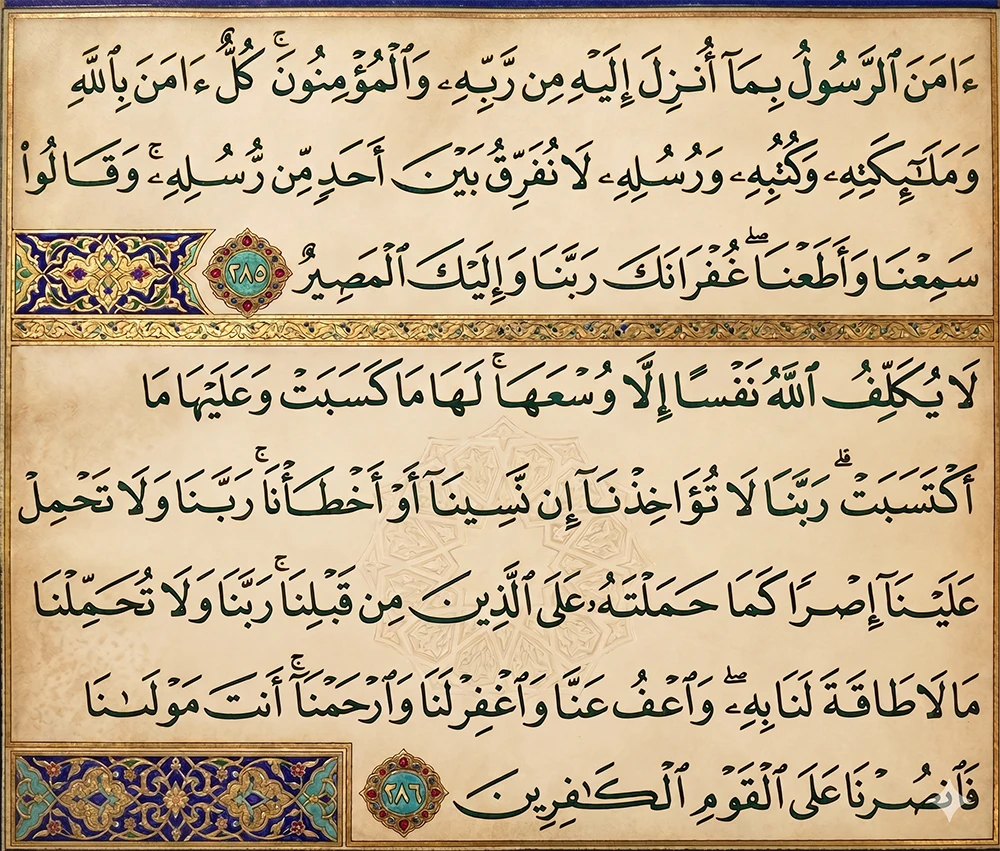
Ayat 285:
“The Messenger has believed in what was revealed to him from his Lord, and [so have] the believers. All of them have believed in Allah and His angels and His books and His messengers, saying: ‘We make no distinction between any of His messengers.’ And they say: ‘We hear and we obey. [We seek] Your forgiveness, our Lord, and to You is the [final] destination.'”
Ayat 286:
“Allah does not burden a soul beyond that which it can bear. It will have [the consequence of] what [good] it has gained, and it will bear [the consequence of] what [evil] it has earned. Our Lord, do not impose blame upon us if we forget or fall into error. Our Lord, and lay not on us a burden like that which You laid on those before us. Our Lord, and burden us not with that which we have no ability to bear. And pardon us; and forgive us; and have mercy upon us. You are our protector, so give us victory over the disbelieving people.”
The transliteration of the last 2 ayats of Surah Baqarah is presented phrase by phrase below. Reading the transliteration alongside the Arabic text trains your tongue on the correct sounds before you attempt independent recitation.
| Arabic Phrase | Transliteration |
|---|---|
| ءَامَنَ ٱلرَّسُولُ | Aamanar-Rasoolu |
| بِمَآ أُنزِلَ إِلَيْهِ مِن رَّبِّهِۦ | bimaaa unzila ilaihi mir-rabbihee |
| وَٱلْمُؤْمِنُونَ | wal-mu’minoon |
| كُلٌّ ءَامَنَ بِٱللَّهِ | kullun aamana billaahi |
| وَمَلَائِكَتِهِۦ وَكُتُبِهِۦ وَرُسُلِهِۦ | wa malaa’ikatihi wa kutubihee wa rusulihee |
| لَا نُفَرِّقُ بَيْنَ أَحَدٍ مِّن رُّسُلِهِۦ | laa nufarriqu baina ahadim-mir-rusulih |
| وَقَالُوا۟ سَمِعْنَا وَأَطَعْنَا | wa qaaloo sami’naa wa ata’naa |
| غُفْرَانَكَ رَبَّنَا | ghufraanaka Rabbanaa |
| وَإِلَيْكَ ٱلْمَصِيرُ | wa ilaikal-maseer |
Ayat 285 — Full Continuous Transliteration:
Aamanar-Rasoolu bimaaa unzila ilaihi mir-rabbihee wal-mu’minoon. Kullun aamana billaahi wa malaa’ikatihi wa kutubihee wa rusulihee. Laa nufarriqu baina ahadim-mir-rusulih. Wa qaaloo sami’naa wa ata’naa. Ghufraanaka Rabbanaa wa ilaikal-maseer.
| Arabic Phrase | Transliteration |
|---|---|
| لَا يُكَلِّفُ ٱللَّهُ نَفْسًا إِلَّا وُسْعَهَا | laa yukalliful-laahu nafsan illaa wus’ahaa |
| لَهَا مَا كَسَبَتْ وَعَلَيْهَا مَا ٱكْتَسَبَتْ | lahaa maa kasabat wa ‘alayhaa maktasabat |
| رَبَّنَا لَا تُؤَاخِذْنَا إِن نَّسِينَا أَوْ أَخْطَأْنَا | rabbanaa laa tu’aakhidhnaa in naseenaaa aw akhta’naa |
| رَبَّنَا وَلَا تَحْمِلْ عَلَيْنَا إِصْرًا | Rabbanaa wa laa tahmil ‘alaynaa isran |
| كَمَا حَمَلْتَهُۥ عَلَى ٱلَّذِينَ مِن قَبْلِنَا | kamaa hamaltahoo ‘alal-ladheena min qablinaa |
| رَبَّنَا وَلَا تُحَمِّلْنَا مَا لَا طَاقَةَ لَنَا بِهِۦ | Rabbanaa wa laa tuhammilnaa maa laa taaqata lanaa bih |
| وَٱعْفُ عَنَّا وَٱغْفِرْ لَنَا وَٱرْحَمْنَا | Wa’fu ‘annaa waghfir lanaa warhamna |
| أَنتَ مَوْلَىٰنَا | anta mawlaanaa |
| فَٱنصُرْنَا عَلَى ٱلْقَوْمِ ٱلْكَٰفِرِينَ | fansurnaa ‘alal-qawmil-kaafireen |
Ayat 286 — Full Continuous Transliteration:
Laa yukalliful-laahu nafsan illaa wus’ahaa. Lahaa maa kasabat wa ‘alayhaa maktasabat. Rabbanaa laa tu’aakhidhnaa in naseenaaa aw akhta’naa. Rabbanaa wa laa tahmil ‘alaynaa isran kamaa hamaltahoo ‘alal-ladheena min qablinaa. Rabbanaa wa laa tuhammilnaa maa laa taaqata lanaa bih. Wa’fu ‘annaa. Waghfir lanaa. Warhamna. Anta mawlaanaa fansurnaa ‘alal-qawmil-kaafireen.
Pronunciation guide: aa = long a (2 counts), oo = long u (2 counts), gh = Arabic غ (guttural from the throat), ‘ = Arabic ع (deep throat constriction). Pronouncing these sounds correctly is a Tajweed skill — if you want to learn Tajweed with a certified teacher properly, it begins with exactly these foundational rules.
Understanding each Arabic word changes how you hear these ayats when you recite them. The tables below map every significant term to its individual meaning.
| Arabic | Transliteration | Meaning |
|---|---|---|
| ءَامَنَ | Aamana | Believed — completed and ongoing simultaneously |
| ٱلرَّسُولُ | ar-Rasoolu | The Messenger (Prophet Muhammad ﷺ) |
| وَٱلْمُؤْمِنُونَ | wal-mu’minoon | And the believers |
| مَلَائِكَتِهِۦ | malaa’ikatihi | His angels |
| وَكُتُبِهِۦ | wa kutubihee | And His books (Torah, Psalms, Gospel, Quran) |
| وَرُسُلِهِۦ | wa rusulihee | And His messengers |
| لَا نُفَرِّقُ | laa nufarriqu | We make no distinction — an active, ongoing commitment |
| سَمِعْنَا | sami’naa | We heard / we hear |
| وَأَطَعْنَا | wa ata’naa | And we obeyed / and we obey |
| غُفْرَانَكَ | ghufraanaka | Your forgiveness — “we seek Your forgiveness” |
| ٱلْمَصِيرُ | al-maseer | The final destination — the ultimate return to Allah |
| Arabic | Transliteration | Meaning |
|---|---|---|
| لَا يُكَلِّفُ | laa yukallifu | Does not burden / does not task or charge |
| نَفْسًا | nafsan | A soul — any soul, universally, no exceptions |
| وُسْعَهَا | wus’ahaa | Its actual lived capacity — not theoretical maximum potential |
| مَا كَسَبَتْ | maa kasabat | What it has earned — good deeds, willful intentional action |
| مَا ٱكْتَسَبَتْ | maa aktasabat | What it has acquired — evil, with the Arabic form implying more deliberate effort toward sin |
| نَسِينَا | naseenaa | We forgot — unintentional lapse of memory |
| أَخْطَأْنَا | akhta’naa | We erred — unintentional mistake, not deliberate sin |
| إِصْرًا | isran | A crushing heavy burden — the word implies something that pins you down |
| طَاقَةَ | taaqata | Ability to bear — physical and spiritual endurance combined |
| ٱعْفُ | ‘afu | Pardon — to cover and conceal a sin as if it never happened |
| ٱغْفِرْ | ighfir | Forgive — to erase the sin from the record entirely |
| ٱرْحَمْ | irham | Have mercy — compassion beyond what justice alone would require |
| مَوْلَىٰنَا | mawlaanaa | Our protector, guardian, master — the one who takes complete responsibility for you |
One term deserves special attention: wus’ahaa. Classical scholars distinguish it sharply from “maximum potential.” It means your actual, current, embodied capacity — including your fatigue, your circumstances, and your grief today. Allah is not measuring you against your best day. He measures against where you genuinely are right now.
Also worth noting: the distinction between maa kasabat (what it earned — good deeds) and maa aktasabat (what it acquired — evil). Classical scholars note that the second Arabic form implies slightly more active striving, suggesting that pursuing evil requires more deliberate effort. Good flows more nakeep the modest islamic dreeturally; evil demands a harder choice.
Ayat 285 of Surah Baqarah opens the closing sequence by establishing what Islamic faith looks like in its most complete form. The verse presents five elements in ascending order, covering belief in all prophets and messengers in Islam without distinction — a foundational Islamic commitment that sets this religion apart:
The verse then closes with an embedded dua: “[We seek] Your forgiveness, our Lord, and to You is the final destination.” This comes immediately after “We hear and we obey” — acknowledging that even fully committed believers remain in need of Allah’s forgiveness. The verse teaches that complete dedication and complete awareness of your shortcomings are not contradictions. They are the natural rhythm of the sincere Muslim.
Ayat 286 opens with a statement of absolute divine principle: “Allah does not burden a soul beyond that which it can bear.” This is not a promise that life will be easy. It is a guarantee that whatever capacity you actually have today — including your fatigue, your mental health, your circumstances — Allah will never demand more than that from you.
The verse then delivers four duas in direct sequence, each addressing a specific dimension of human limitation.
“Our Lord, do not impose blame upon us if we forget or fall into error.”
This dua was revealed directly in response to companions who feared accountability for thoughts and unintentional lapses. Ibn Abbas confirmed that Allah does not hold believers accountable for passing thoughts, genuine forgetfulness, or unintentional mistakes — only for conscious choices. The Prophet ﷺ confirmed this: Allah has lifted accountability for forgetfulness, genuine error, and acts committed under compulsion from this Ummah entirely.
“Our Lord, and lay not on us a burden like that which You laid on those before us.”
Previous religious communities carried legal codes of extraordinary weight — proportional to their specific historical responsibilities. This dua asks Allah to sustain Islam’s character as a religion of ease, extending the mercy given to this Ummah across all generations. When you recite it, you join every Muslim since the Prophet’s time who has stood before Allah and asked to remain within that mercy.
“Our Lord, and burden us not with that which we have no ability to bear.”
This is the most personally direct dua in the ayat. It gives believers explicit permission to petition Allah honestly when a trial feels genuinely beyond their strength — not as complaint, but as the most honest conversation possible with the Creator. Scholars across centuries have recommended this specific phrase during moments of overwhelming crisis: illness, loss, financial ruin, family collapse.
“And pardon us; and forgive us; and have mercy upon us. You are our protector, so give us victory over the disbelieving people.”
Classical scholars note these three requests — al-‘afw (pardon: to cover a sin as if it never happened), al-maghfirah (forgiveness: to erase it from the record), and ar-rahmah (mercy: compassion beyond what justice requires) — proceed from the particular to the general, from branch to root. The closing petition asks for victory over the disbelieving people, which scholars interpret broadly for modern Muslims: victory over spiritual opposition, over internal weakness that pulls you away from faith, and over the external pressures that make Islamic life difficult.
The hadith of Abu Mas’ud reports that the Prophet ﷺ said: “Whoever recites the last two verses of Surah Al-Baqarah at night, they will suffice him.” (Sahih Bukhari 5009, Muslim 808). Scholars interpret “suffice” as protection from harm, evil, and spiritual disturbance throughout the night. This is why, for fourteen centuries, Muslims across every language, culture, and circumstance have ended their day with these same last 2 verses — because the Prophet ﷺ ended his with them too.
These last two verses of Surah Baqarah were revealed to Prophet Muhammad ﷺ from beneath the Throne of Allah during the Night Journey (Isra’ and Mi’raj) — directly, without the intermediation of Jibreel, as a gift granted to no prophet before him. This unique status elevates their rank above ordinary Quranic recitation. Every time you recite them, you are reciting words whose manner of delivery was reserved exclusively for this Ummah — for you specifically, as part of the community Muhammad ﷺ was sent to.
Ayat 285 of Surah Al-Baqarah contains the five pillars of Iman in their most complete Quranic formulation: belief in Allah, angels, books, messengers, and the commitment to hear and obey. On the days when your faith feels distant or complicated, reciting this single verse is a return to its simplest and most complete form — a reminder of exactly what you believe and why.
Dua 1 of Ayat 286 directly addresses the anxiety of imperfection — the fear of being held responsible for mistakes made in forgetfulness or genuine error. This is the verse for the Muslim who prayed but forgot a step, who intended well but acted imperfectly, who is trying but knows their trying is incomplete — and who needs to hear, in Allah’s own words, that He knows the difference between a mistake and a choice.
Dua 2 of this ayat — asking Allah not to burden this Ummah as previous communities were burdened — is a petition for the sustained mercy that makes Islam a religion of ease. It is particularly relevant for Muslims who feel crushed by the gap between what their faith asks and what their current life allows — the working parent who misses Fajr, the new Muslim still learning — this dua reminds them that Allah’s design for this religion already accounts for their humanity.
These last 2 ayats of Surah Baqarah are among the most recommended starting passages for students beginning Hifz, for three practical reasons: their length is manageable at approximately 70 words, their meaning is directly motivating for daily practice, and the nightly recitation sunnah means you are using what you memorize from day one. If these 2 ayats are your starting point, Hafizon’s structured Quran memorization program is designed to take you from here to wherever your Hifz goal ends.
The central statement of Ayat 286 of Surah Al-Baqarah — “Allah does not burden a soul beyond that which it can bear” — combined with the three-part request for pardon, forgiveness, and mercy, creates a complete spiritual response to overwhelm. This is the verse Muslims return to during illness, loss, and the moments when the weight of daily life stops feeling manageable — not because it removes the weight, but because it confirms the weight was never supposed to be carried alone

The last 2 ayats of Surah Baqarah are verses 285 and 286 of Surah Al-Baqarah (Chapter 2). Ayat 285 establishes the complete foundations of Islamic faith. Ayat 286 declares that Allah does not burden any soul beyond its capacity and contains four powerful duas addressing forgiveness, burden, and mercy.
Ayat 285 means: the Messenger and all believers affirm faith in Allah, His angels, His books, and all His messengers without distinction — and commit to hearing and obeying, while seeking Allah’s forgiveness. Ayat 286 means: Allah guarantees no burden exceeds a soul’s capacity, and contains four duas believers can use to petition Allah for forgiveness of mistakes, protection from excessive burdens, pardon, mercy, and victory.
The Prophet ﷺ confirmed these last 2 verses “suffice” whoever recites them at night, providing spiritual protection and sufficiency. They were also given to the Prophet ﷺ as a direct gift from beneath Allah’s Throne — a distinction granted to no previous prophet. Their regular recitation renews Iman — and for those looking to build on this foundation, a structured online Quran learning program for beginners is the natural next step.
The primary recommended time is before sleeping, based on the authentic hadith in Sahih Bukhari (5009) and Sahih Muslim (808). They are also recited during night prayers (Tahajjud and Witr), as part of your nightly adhkar routine, and as part of daily Quran recitation. There is no prohibition on reciting them at any time of day.
Based on the hadith of the Prophet ﷺ — “whoever recites the last two verses of Surah Al-Baqarah at night, they will suffice him” — scholars affirm that reciting them with presence, understanding, and intention provides the spiritual sufficiency and protection the hadith describes. The condition scholars emphasize is conscious, attentive recitation rather than rushed mechanical repetition.

Understanding the last 2 ayats of Surah Al-Baqarah in full — their Arabic structure, their four duas, their meaning phrase by phrase — is the necessary foundation for any Muslim who wants to recite them with genuine presence rather than habit.
But there is a next step that understanding alone cannot give you: hearing these verses recited correctly by a qualified teacher, having your own recitation corrected in real time, and building the Tajweed habits that make every surah you recite after this one more precise and more complete.
The Tajweed rules that govern these last 2 verses of Surah Baqarah — the Ghunna in Rabbanaa, the Idghaam in laa nufarriqu baina, the Madd in al-maseer — are the same rules that govern every word of the Quran. Learning them properly through these 2 ayats, with a certified teacher who can hear and correct your recitation live, is the fastest way to establish a correct Quranic reading habit from the very beginning.

Hafizon Academy’s Tajweed program is built for exactly this: one-on-one sessions, certified teachers, and lessons structured around where you actually are — whether you are starting with these last 2 ayats of Surah Al-Baqarah or building on an existing foundation. Book a free trial class and recite these verses with a teacher before your next session.

